Let us be honest about how most multi-branch businesses in Bangladesh are managed today.
You call Branch 2 at 10am to ask how sales are going. They give you a rough number from memory. You call Branch 3 at noon to check if they need stock transferred. Someone reads out a handwritten count. At the end of the day, you collect sales figures from each branch via WhatsApp, add them up in a notebook or Excel sheet, and try to piece together a picture of how your whole business performed.
It works — just barely. But it is exhausting, error-prone, and completely unsustainable as you grow.
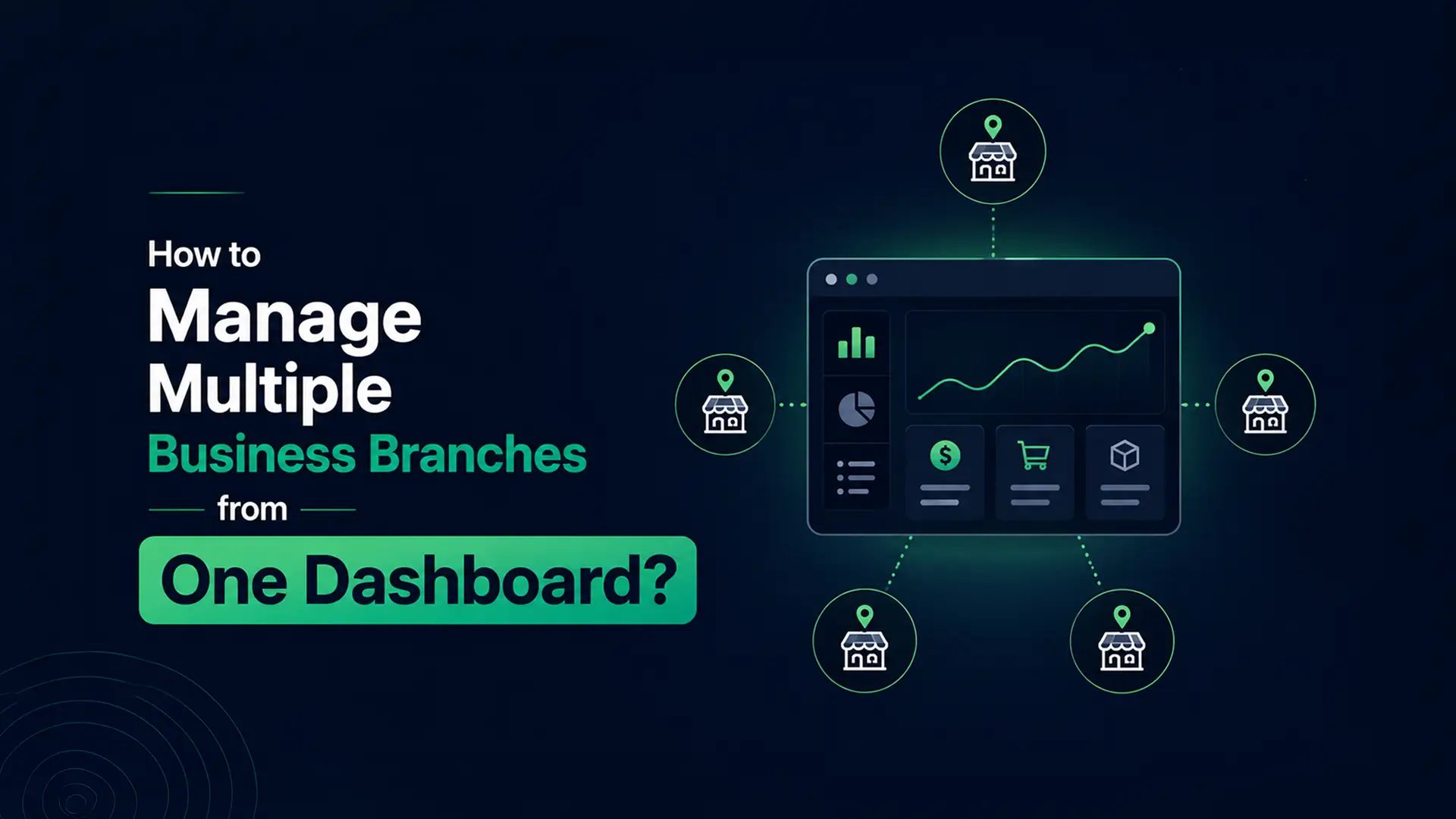
There is a better way. Modern multi-branch management software gives you a single dashboard where every outlet feeds data in real time — sales, stock, staff activity, and daily profit — without a single phone call. You can manage your entire business from your phone, from anywhere in the country.
This guide explains how it works, what features matter, and how businesses in Bangladesh are using it right now to run three, five, or ten outlets as efficiently as one. If you are still deciding between cloud and offline systems generally, start with our Cloud POS vs Offline POS guide.
Why Managing Multiple Branches Is So Difficult Without the Right System?
The challenges of running multiple business locations are not just about distance. They are about information — or rather, the lack of it.
1. You never have a real-time picture of your business
When your sales data comes from phone calls and WhatsApp messages, it is always slightly out of date. By the time you hear that Branch 3 is running low on stock, they may have already turned away customers. By the time you learn that Branch 2 had a slow day, it is too late to do anything about it. Real-time visibility changes everything — you see problems as they happen, not hours later.
2. Stock management becomes a guessing game
Without a central inventory system, each branch manages its own stock independently. That means Branch 1 might have excess stock of a product that Branch 3 desperately needs — but nobody knows until it becomes a problem. Overstocking in one location and stockouts in another is one of the most common and most expensive inefficiencies in multi-branch retail businesses.
3. Pricing and product consistency break down
When each branch manages its own product list and pricing independently, inconsistencies creep in. A customer who visits your Branch 1 in Dhanmondi and then your Branch 2 in Uttara may find different prices for the same product — and that damages your brand reputation and customer trust in ways that are hard to recover from.
4. Staff accountability is nearly impossible to enforce
Without a centralised system, you are trusting your branch managers to report accurately. Most of them do. But without digital records, there is no way to verify. Cash discrepancies, unrecorded discounts, and inventory shrinkage are far more common in businesses that rely on manual reporting than in those with a digital audit trail for every transaction.
5. Your time gets consumed by coordination
Every hour you spend calling branches, chasing reports, and manually consolidating data is an hour you are not spending on growing your business. For business owners running three or more locations, this coordination overhead can consume half their working day — and it scales badly as you open more outlets.
What Multi-Branch Management Software Actually Does?
A multi-branch POS and business management system connects all your locations to a single cloud-based platform. Every sale, every stock update, every staff action at every outlet feeds into the same system in real time. You see everything from one dashboard, without having to call anyone.
Here is what that means in practice.
1. Centralised product and pricing management
You set your product catalogue and pricing once — from your central dashboard — and it applies consistently across every branch automatically. When you launch a new product, add a seasonal discount, or update a price, you make the change in one place and it takes effect everywhere simultaneously. No more WhatsApp messages to branch managers. No more inconsistent pricing between locations.
2. Real-time sales visibility across all outlets
Your dashboard shows you live sales figures for every branch — updating in real time as transactions are processed. You can see the total sales for your entire business right now, or drill down to see exactly what Branch 2 has sold in the last two hours. No phone calls, no waiting, no approximations.
3. Stock tracking and inter-branch transfers
Your inventory dashboard shows you stock levels at every location simultaneously. When you see that Branch 1 has excess stock of a product that Branch 3 is running low on, you can initiate a stock transfer directly from the dashboard — creating a digital record of the movement that both branches can see. No paperwork, no confusion about quantities.
4. Role-based staff access
Every staff member gets access only to the parts of the system relevant to their role. A cashier at Branch 2 can process sales and view their own shift summary — but cannot see the financial reports for other branches or change product pricing. A branch manager can see all data for their own outlet but not for others. You, as the owner, see everything. This structure creates accountability without exposing sensitive business information to the wrong people.
5. Consolidated reporting across all branches
Instead of manually combining sales figures from each branch, your reporting dashboard does it automatically. You can see your total business performance — all outlets combined — or compare branches side by side. Which outlet had the best week? Which product sold most across your entire network? Which branch has the highest staff cost relative to revenue? All of this is visible instantly, without a single spreadsheet.
Key Features to Look for in Multi-Branch Management Software
Not all POS systems handle multiple branches well. Here are the specific features that matter when you are managing more than one location — see the complete list on our features page.
1. Centralised product catalogue with per-branch pricing option
You need one product catalogue that applies to all branches — but with the flexibility to set different prices for different locations if your cost structure varies. A shop in Gulshan may have different rent and operating costs than one in Narayanganj, and your pricing might need to reflect that.
2. Live stock levels per outlet
Stock is tracked separately at each branch but visible centrally. You see not just your total inventory across the network, but the specific stock level at each individual location. This is essential for managing stock transfers and making purchasing decisions.
3. Inter-branch stock transfer with digital records
When you move stock from one branch to another, the system should record the quantity transferred, the date, and the staff member who initiated it — and update both branches’ inventory automatically. This creates an audit trail and eliminates the disputes that arise from informal stock movements.
4. Branch-level and consolidated reporting
You need to be able to see performance for each branch individually and for your whole business combined. Separate views help you identify which locations are performing well and which need attention. Consolidated views help you understand the overall health of your business.
5. Role-based user access
The system should support multiple user roles with different permission levels — owner, manager, cashier, warehouse staff — with access scoped appropriately for each role and each branch. This is not optional for any business serious about financial control.
6. Mobile access for the owner
You should be able to check your entire business’s performance from your phone, from anywhere. If you are visiting a supplier in Chittagong, you should still be able to see real-time sales figures for your Dhaka branches. If you are at home on a Sunday evening, your daily report should be a tap away.
7. Offline-first operation at each branch
Each branch should be able to operate fully offline if its internet connection drops. Sales continue, inventory updates locally, and receipts print — with everything syncing to the central dashboard automatically when connectivity returns. One branch’s internet problem should never affect the rest of the network. We cover this in more depth in our Cloud POS vs Offline POS comparison.
How DeshiPOS Handles Multi-Branch Management?
DeshiPOS was designed with multi-branch businesses in mind from the beginning. Here is exactly what you get when managing multiple outlets on DeshiPOS — whether you run retail stores, restaurants, pharmacies, or fashion outlets.
1. One dashboard, all branches
From your DeshiPOS owner dashboard, you see live sales, inventory, and staff activity for every outlet simultaneously. Switch between branches with a single click. Compare their performance side by side. See your total business revenue for today, this week, or this month — all without leaving your desk or making a single phone call.
2. Centralised product and pricing control
Add a new product once and it appears across all your outlets. Update a price centrally and every branch gets the change immediately. Run a promotion across your entire network with a single action. Your brand stays consistent and your pricing stays accurate — everywhere, all the time.
3. Real-time inventory across all locations
DeshiPOS tracks your stock at each branch in real time. When Branch 1 sells five units of a product, that deduction happens immediately and is visible in your central dashboard. Low-stock alerts fire when any branch’s inventory drops below the threshold you set — so you always know before a branch runs out.
4. Digital stock transfers between branches
Initiate a stock transfer from your dashboard. Specify the product, the quantity, the source branch, and the destination branch. The system records the transfer, deducts from the source, and credits the destination — creating a clean digital record that both branch managers can see. No more confusion about what was sent and when.
5. Role-based access for every team member
Set exactly what each staff member can see and do. Cashiers at Branch 2 can only access Branch 2’s billing screen. Branch 3’s manager can see Branch 3’s full data but not other branches. Your accountant can access financial reports across all branches without touching billing or inventory settings. You, as the owner, have full visibility and full control.
6. Mobile access from anywhere
DeshiPOS runs in any browser on any device. Check your sales from your phone while you are stuck in Dhaka traffic. Approve a stock transfer from your laptop at home. Review your weekly profit report during your morning tea. Your business is always with you — without you needing to be physically present anywhere.
7. Plans that grow with your business
DeshiPOS’s Growth plan supports up to 3 outlets at ৳1,199 per month. The Business plan supports up to 10 outlets at ৳1,999 per month with unlimited users and products. For businesses with more complex needs, custom plans are available. All plans include multi-branch stock management, centralised reporting, and role-based access as standard features. See full details on our pricing page.
Real-World Scenarios: What Changes When You Go Centralised?
Here are three specific scenarios that illustrate the practical difference a centralised management system makes for multi-branch businesses in Bangladesh.
Scenario 1: Stock running out at one branch
Without a central system: Branch 2’s manager calls you at 4pm to say they are almost out of your bestselling product. You call Branch 1 to check if they have excess. They count manually and call back 20 minutes later. You arrange a delivery. By the time the stock arrives, you have already missed two hours of peak sales.
With DeshiPOS: Your dashboard sends you an automatic low-stock alert for Branch 2 at 11am — before the problem becomes critical. You check Branch 1’s stock level directly in the dashboard. You initiate a transfer digitally in two minutes. Branch 1’s manager sees the transfer request, confirms it, and the delivery is arranged before the lunchtime rush begins.
Scenario 2: End-of-month performance review
Without a central system: You spend the first day of every month calling each branch, collecting sales figures, typing them into Excel, and trying to calculate which outlet performed best and what the business’s total profit was. This typically takes half a day — and the numbers are only as accurate as whoever gave them to you.
With DeshiPOS: On the last day of the month, you open your reporting dashboard and click “Monthly Summary.” You see total revenue, total cost, gross profit, best-selling products, and individual branch performance — all calculated automatically from real transaction data. The entire review takes 15 minutes instead of half a day.
Scenario 3: Launching a promotion across all branches
Without a central system: You send a WhatsApp message to all branch managers explaining the promotion details. Some implement it correctly. Some get the discount percentage wrong. One branch forgets entirely. Customers at different branches get different deals, and your brand looks inconsistent.
With DeshiPOS: You configure the promotion once in your central product settings. It applies automatically at every checkout across all branches simultaneously. Every customer, at every location, gets exactly the same promotion — with zero room for human error or inconsistency.
Frequently Asked Questions: Multi-Branch Management in Bangladesh
1. How many branches can I manage with DeshiPOS?
The Growth plan supports up to 3 outlets and the Business plan supports up to 10 outlets. For businesses with more than 10 locations, DeshiPOS offers customised enterprise plans. Contact the sales team to discuss your specific requirements.
2. Can each branch operate independently if the internet goes down?
Yes. DeshiPOS is built offline-first at every outlet. If Branch 3 loses its internet connection, it continues processing sales, updating its local inventory, and printing receipts without interruption. When connectivity returns, all data syncs automatically to the central dashboard.
3. Can I set different prices for different branches?
DeshiPOS supports centralised pricing that applies to all branches, with the ability to configure outlet-specific variations where needed. This gives you consistency across your network while allowing for legitimate price differences between locations.
4. How does stock transfer work between branches?
You initiate a stock transfer from your central dashboard — specifying the product, quantity, source branch, and destination. The system creates a transfer record, notifies the relevant branch managers, and updates both locations’ inventory automatically when the transfer is confirmed. A complete transfer history is maintained for audit purposes.
5. Can I see which branch is performing best?
Yes. Your reporting dashboard lets you compare branches side by side — by revenue, by profit margin, by transaction volume, or by product category. You can filter by time period — today, this week, this month, or a custom range — to understand performance trends over time.
6. Is multi-branch management included in all DeshiPOS plans?
Multi-branch management is available from the Growth plan upward. The Starter plan is designed for single-outlet businesses. If you are currently on the Starter plan and ready to open a second location, upgrading to Growth is a straightforward process with no data loss. See our pricing page for full plan comparisons, or check our FAQ for more answers.
Stop Managing Your Business Branch by Branch — Start Managing It as a Whole
The businesses that scale successfully in Bangladesh are the ones that build systems early — before the coordination overhead becomes overwhelming. Going from two branches to five is exciting. Going from five to ten is a completely different challenge if you are still managing everything manually.
A centralised management system does not just save you time. It gives you the clarity to make better decisions, the control to maintain consistency across locations, and the confidence to open new branches knowing you have the tools to manage them properly from day one.
DeshiPOS is built for exactly this. Whether you have two outlets today or are planning ten, the platform grows with you — giving you the same real-time visibility, the same centralised control, and the same reliable offline operation at every location.
Start with a free trial and see how different it feels to manage your entire business from one screen.
Related reading: Cloud POS vs Offline POS in Bangladesh | DeshiPOS vs Ehishab vs PridePOS | All DeshiPOS features | Pricing and plans | DeshiPOS for retail | FAQ
